Consultant vs specialist dentist: what is the difference?
A general dental practitioner (GP) is a licensed dentist who treats everyday problems across the whole of dentistry. A dental specialist has completed recognised advanced training in one branch, such as orthodontics or endodontics. A dental consultant holds the most senior grade on the professional ladder, reached through higher qualifications and many years of experience in a stated field.
The titles are therefore professional grades confirmed by the licensing authority, not labels a dentist chooses. People who search for “consultant vs specialist dentist” usually want to know who is better. The more useful question is: a consultant, or a specialist, in what?
Who decides the title in Kuwait?
No dentist may practise in Kuwait, in a government or a private clinic, without a professional licence from the Ministry of Health. The title printed on that licence reflects the dentist’s recognised degrees and years of experience, under ministerial rules that are revised from time to time.
That makes the licence the reference point, rather than a signboard or a social media profile. You are entitled to ask which title appears on it, and a clinic that is confident in its dentists will not mind the question.
What does a general dental practitioner do?
The GP is usually the first dentist you see: examinations and X-rays, cleaning, fillings, straightforward root canal treatment, simple extractions and crowns. The range is wide, and an important part of the role is recognising when a case sits within it and when it should be referred.
A GP title does not mean a weaker dentist, just as a senior title does not mean every treatment its holder offers is better. What counts is training and experience in the particular treatment you need.
What is a dental specialist?
Specialisation means a formal postgraduate training programme in one defined branch. In the United States, for example, the National Commission on Recognition of Dental Specialties recognises 12 specialties, among them orthodontics, endodontics, periodontics, oral and maxillofacial surgery, paediatric dentistry and prosthodontics. Patients know the practitioners by familiar names: the orthodontist for braces and bite problems, the endodontist for difficult root canals, the periodontist for gum disease, and the specialist in prosthodontics for complex crowns, bridges and dentures.
In the United Kingdom the General Dental Council keeps specialist lists. A dentist does not have to join a list to work in that field, but only a dentist on the relevant list may use the title “specialist” for it.
One point worth noticing: cosmetic dentistry is not one of the 12 specialties on the American list. “Cosmetic dentist” describes the kind of work a dentist concentrates on, not a specialist title, so the right question is about training and previous cases in cosmetic treatment.
What does “consultant” add?
A consultant has reached the top grade: higher qualifications, longer experience and, often, responsibility for planning and overseeing complex cases. But the grade is always attached to a field: a consultant in orthodontics, in oral surgery, in comprehensive dentistry. When you read “consultant” on a door, keep reading to see what follows it.
This is why the consultant-or-specialist question has no single answer. A consultant in a field you do not need is of less use to you than a specialist in exactly your problem. Match the field to the treatment first, then compare grades.
Where does comprehensive dentistry fit?
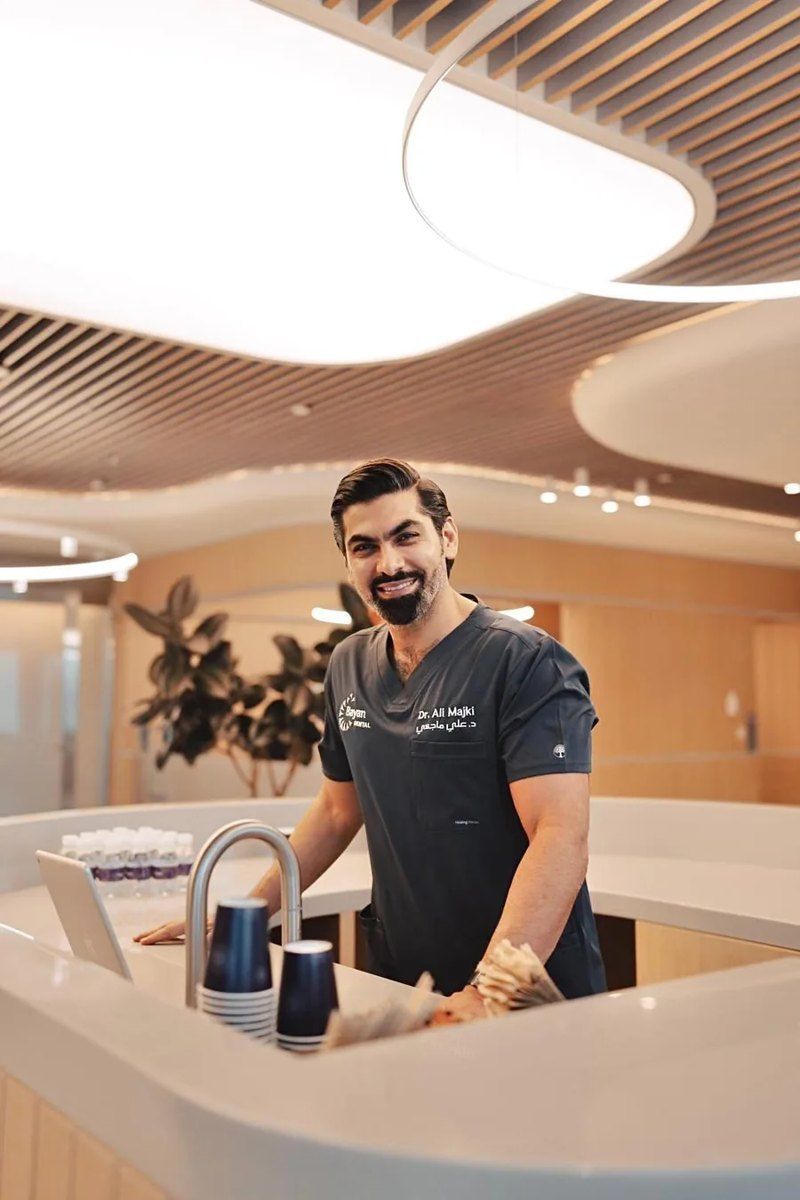
Comprehensive dentistry treats the mouth as one unit: the dentist diagnoses, sets priorities, carries out the restorative and cosmetic work personally and refers what belongs to another discipline. Dr. Ali Majki’s title is Consultant in Comprehensive & Cosmetic Dentistry, with more than 20 years in practice. He qualified with a DDS from the University of Missouri-Kansas City in 2005, then gained the MFD in 2008 and the MGDS in 2011 from the Royal College of Surgeons in Ireland (RCSI).
The RCSI Faculty of Dentistry today describes the MGDS as an examination assessing comprehensive knowledge across all areas of general dental practice, open to dentists at least three years after graduation. These are higher qualifications in comprehensive care, not a certificate in a single specialty. That is why implant surgery and gum grafting, for instance, are carried out by a specialist, while Dr. Majki provides the restorative and prosthetic stage on top.
How do you ask a dentist about scope?
Take these questions with you; all of them are ordinary and reasonable. Which title is on your Ministry of Health licence, and in which field? How often do you carry out this particular treatment, and can I see similar cases? Which parts of my plan will you do yourself, and which will you refer? Who performs the surgery if the plan includes implants? If there is a complication, who looks after it?
A clear answer is a good sign. A dentist who says “that part is not my field, and I will send you to someone who does it every day” deserves more trust than one who claims to do everything.
When should you see a specialist directly?
Some problems belong with a specialist from the start: complex orthodontics or a jaw discrepancy, a root canal that needs retreatment or has calcified canals, advanced gum disease with bone loss, surgical extractions or implants that need bone augmentation, and young children who need a paediatric approach.
In large cases the comprehensive dentist and the specialists work as a team: one plans, coordinates and keeps the whole picture in view, and each carries out the part they trained for. The patient benefits when everyone knows their limits.
Scientific sources
National Commission on Recognition of Dental Specialties and Certifying Boards. Recognized Dental Specialties. ncrdscb.ada.org/recognized-dental-specialties (accessed November 2026).
General Dental Council (UK). Specialist lists. gdc-uk.org/registration/your-registration/specialist-lists (accessed November 2026).
Faculty of Dentistry, Royal College of Surgeons in Ireland. MFD Examination and MGDS Examination. facultyofdentistry.ie/examinations/general-examinations (accessed November 2026).
Frequently asked questions
Is a dental consultant better than a dental specialist? Not automatically. A specialist has advanced training in one branch; a consultant holds a more senior grade. What matters is that the dentist’s field matches the treatment you need.
Who should place my dental implant? The surgery is normally done by a dentist with surgical specialist training, such as an oral surgeon or a periodontist. The crown or bridge on top can be made by a restorative or comprehensive dentist.
Do I need an orthodontist for clear aligners? Mild and moderate alignment is often treated by trained general or comprehensive dentists. Severe crowding, extractions and jaw problems should be assessed by an orthodontist.
Is “cosmetic dentist” an official specialty? It is not among the 12 specialties recognised in the United States, for example. Treat it as an area of focus and ask about training and previous cases.
How can I check a dentist’s title in Kuwait? Ask the clinic which title appears on the Ministry of Health licence, and ask about the university, the postgraduate qualifications and the years they were awarded.
Where can I see a consultant in comprehensive and cosmetic dentistry in Kuwait? Dr. Ali Majki sees patients at Aline Dental in Shaab, Kuwait; patients come to him from across Kuwait — from Jahra to Al-Rai and The Avenues — and from Doha and Qatar.