What are the steps of Invisalign treatment?
Invisalign treatment follows seven stages: an assessment with X-rays and photographs, a digital scan, a computer-planned sequence of tooth movements, fitting of the first aligners and any attachments, months of daily wear with scheduled aligner changes, a refinement stage if some teeth lag behind, and retainers to hold the result. The brand is often typed as “invisaline” or “invisilign”; the steps below apply to it and to other clear aligners.

Step 1: Is your case suitable?
The first visit is diagnostic. The teeth, gums and bite are examined, X-rays are checked for bone levels and roots, and any decay or gum inflammation is treated before teeth are moved. This is also when you hear honestly whether aligners can do the job alone, or whether fixed braces or a referral to an orthodontist would serve you better.
Step 2: The scan and the digital plan
An intraoral scanner records the teeth in three dimensions. The plan is then built in software, called ClinCheck in the Invisalign system, which shows each tooth moving from its present position to the proposed final one and estimates the number of aligners.
The simulation is a plan, not a promise. It is reviewed and adjusted by the treating dentist before the aligners are ordered, and it is the right moment to ask what the result will look like and how it fits any later cosmetic work.
Step 3: First aligners, attachments and making space
At the fitting visit, small tooth-coloured composite shapes called attachments may be bonded to certain teeth to give the aligner something to grip. Where teeth are crowded, a fraction of a millimetre of enamel may be polished away between selected teeth to create room. You are shown how to seat and remove the trays and are given the first sets.
Step 4: How many hours a day, and how often to change?
The manufacturer advises wearing the aligners 20 to 22 hours a day, removing them only to eat, to drink anything other than water, and to brush and floss. Teeth respond to steady, light pressure, so hours missed are movement lost.
How often each aligner is changed is set by the clinician. A randomised trial of 80 patients (Al-Nadawi et al., 2021) compared changes every 7, 10 and 14 days: the 14-day schedule was slightly more accurate for some back-tooth movements, but the difference was below the threshold of clinical significance, and the 7-day group finished in roughly half the time (about five months against nine).
Step 5: Review visits
Progress is checked at intervals, in person or with photographs, to confirm that each aligner is fitting fully before the next series is handed over. An aligner that no longer sits flush on a tooth is the early sign that the tooth is not tracking, and it is easier to correct at this stage than at the end.
Step 6: Why are refinements so common?
Teeth do not follow the software exactly. A prospective study (Haouili et al., 2020) found that the mean accuracy of Invisalign across all tooth movements was 50%, with rotations and some intrusion movements the least predictable. A systematic review (Robertson et al., 2020) concluded that most tooth movements may not be accomplished with a single set of trays.
So a refinement, meaning a new scan and an additional short series of aligners, is a normal part of treatment rather than a failure. It is worth asking at the start whether refinements are expected in your plan.
Step 7: The last aligner and retainers
When the final position is reached, the attachments are polished off and retainers are made. Teeth tend to drift back at any age, so retention is part of the treatment, not an optional extra.
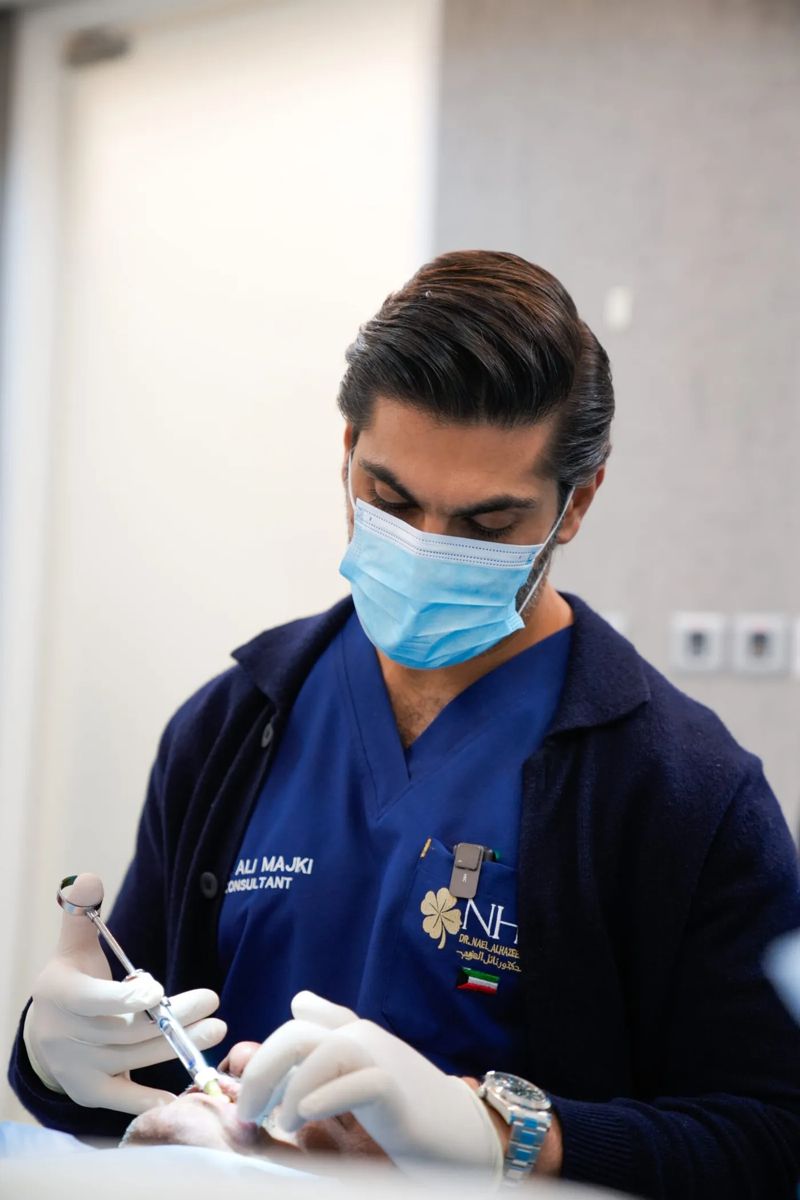
If veneers, bonding or whitening are planned, they come after alignment. At Aline Dental in Shaab, Dr. Ali Majki plans aligner treatment inside the overall smile design, so teeth are moved to where later restorations need them, and complex bite problems are referred to an orthodontist.
Scientific sources
Haouili N., Kravitz N.D., Vaid N.R., Ferguson D.J., Makki L. Has Invisalign improved? A prospective follow-up study on the efficacy of tooth movement with Invisalign. American Journal of Orthodontics and Dentofacial Orthopedics, 2020. doi:10.1016/j.ajodo.2019.12.015
Robertson L. et al. Effectiveness of clear aligner therapy for orthodontic treatment: a systematic review. Orthodontics & Craniofacial Research, 2020. doi:10.1111/ocr.12353
Al-Nadawi M. et al. Effect of clear aligner wear protocol on the efficacy of tooth movement. The Angle Orthodontist, 2021. doi:10.2319/071520-630.1
Frequently asked questions
How long does Invisalign take from start to finish? It varies with the complexity of the case, the plan and how consistently the aligners are worn; mild corrections take months, larger ones considerably longer.
Does Invisalign hurt? Most people feel pressure or tenderness for the first day or two of each new aligner, which is the sign that the teeth are moving.
Can I drink coffee with invisaline trays in? Remove them for anything other than water; hot or coloured drinks can warp and stain the plastic and hold sugar against the teeth.
What are Invisalign attachments? Small tooth-coloured bumps bonded to some teeth so the aligner can apply force in the right direction; they are removed at the end.
What if I lose an aligner? Contact the clinic; you will usually be told either to move to the next aligner or go back to the previous one until a replacement arrives.
Where can I start Invisalign in Kuwait? Dr. Ali Majki sees patients at Aline Dental in Shaab, Kuwait; patients come to him from across Kuwait — from Jahra to Al-Rai and The Avenues — and from Doha and Qatar.